
Livingston County Arrest Reports
The county's official blotter lives in the LCSO press-release archive, sorted by category and year. It is not a rolling feed. Nothing there promises a 72-hour or seven-day list. Periodic releases can group a month of incident dates, covering warrant arrests, citations, summons releases, and transfers to Caldwell County Detention Center. The newest roster shows who is booked now. The archive supplies the narrative context.
Chillicothe Police also posts a press-release index with daily-style bulletins. Typical entries list calls for service, an arrest narrative, transport to CCDC, and case follow-up. No booking-photo gallery appears there. Utica and Wheeling publish no separate municipal arrest log, so the sheriff archive serves as the practical county-wide source.
Read Livingston's Arrest Blotter
Check the release date first. Then trace each incident date. The two often diverge, since a report may go up after several days of work, and a single release can summarize several events.
- Open the official LCSO press-release index.
- Choose the relevant year and scan arrest, incident, or periodic report titles.
- Record the incident date, report date, agency, location, and custody outcome separately.
- Check whether the person was jailed, transferred, cited, or released on summons.
- Use the LCSO roster for present custody and Case.net for the later court case.
- Request the underlying record when the archive does not reach the needed date.
For a truly fresh intake, turn to Arrested Today. That same-day roster and this multi-day blotter are not duplicate sources.
Livingston Arrest Entry Fields
Narrative reports read differently from roster cards. They add context the intake data lacks, but may omit the booking number, the image, or the exact custody status.
| Report detail | How to read it |
|---|---|
| Incident date | When the reported event occurred, not always the publication date. |
| Agency | The sheriff, city police, or another named office involved. |
| Arrest narrative | A summary of alleged conduct and officer action. |
| Charge or warrant | An charge or process basis, not a conviction. |
| Transport | A stated move to CCDC or another location. |
| Summons or release | A custody outcome that may never appear as a long jail stay. |
| Follow-up | Referral to a prosecutor, juvenile office, or court process. |
| Photo | Not shown in the sampled narrative bulletins; check the roster when available. |
Report date, booking date, and court filing date each mark a different stage. Keep every date tied to its source. A later correction belongs beside the original agency entry, not merged into an unofficial summary. When an agency or outcome is missing, request it.
Livingston's Periodic Release Pattern
Local radio extends the county's reach. The sheriff's December incidents, arrests, and citations report republished by KTTN shows how an outlet carries the county narrative past the official page.
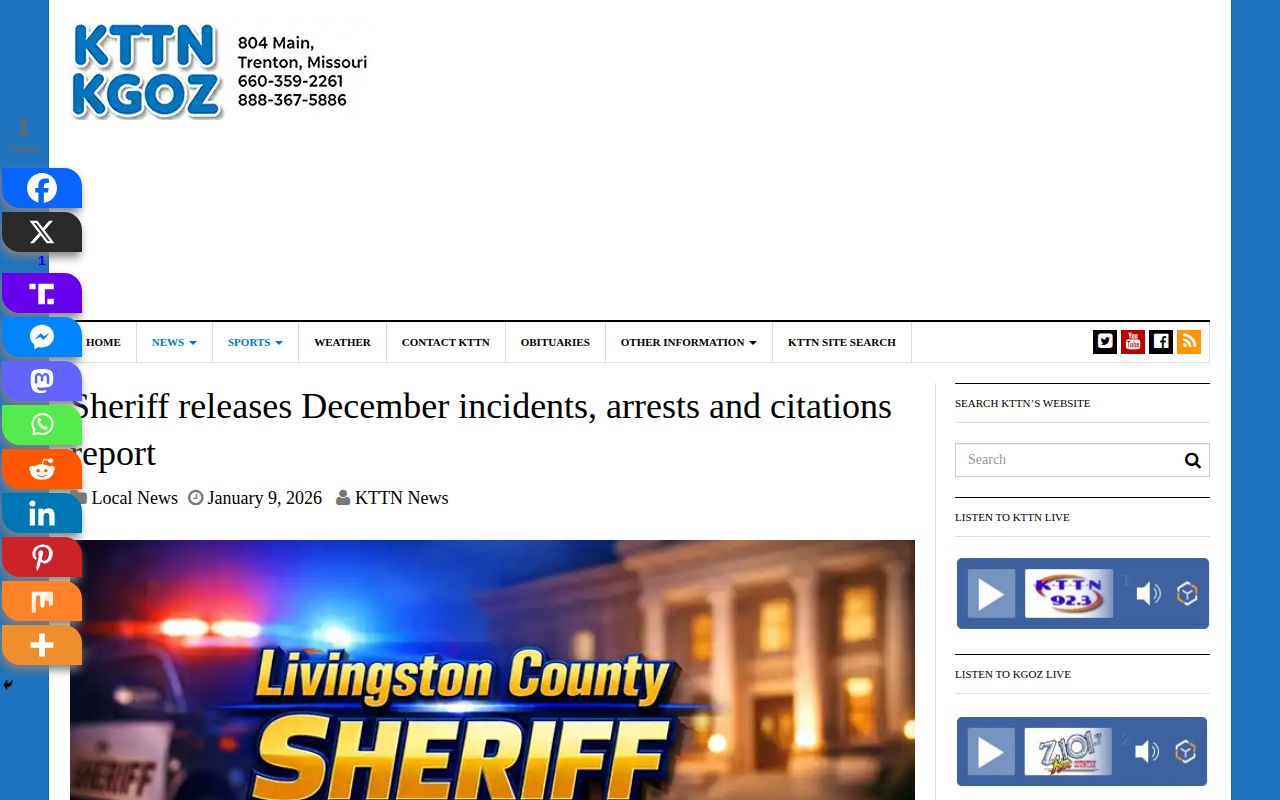
KTTN is a secondary copy. Check it against the sheriff's own release or a requested record. The August 2026 release shows that same grouping style. It spans several incident dates at once. Arrests, citations, warrant activity, transfers, and summons outcomes all sit side by side. That structure helps reconstruct a week of activity, but it is not a full booking ledger.
Weekend Livingston Arrest Reports
The sheriff posts no separate weekend or holiday schedule. A weekend arrest may surface first on the roster. Later it can appear in a periodic release. Sometimes the only trace sits in a record you have to request. "Continuously updated" describes the redesigned booking site, not a promise of fixed release intervals. So search a range of release dates. Review the Current and Released roster tabs, since a short stay can end before the blotter posts. Then check a Chillicothe bulletin when city police made the arrest, and remember that an empty archive is not proof of silence.
Note: Treat weekend “surges” as a search problem, not a supported claim about the number of arrests.
Local Livingston Arrest Coverage
Older sheriff coverage survives on Northwest Missouri Info. Its May 2023 Livingston report is one dated secondary archive worth knowing about.
Secondary archives are selective. Use them only to locate an old topic. KTTN, Northwest Missouri Info, and KXCV/KRNW can cover major local events. So can aggregators. RecentlyBooked and similar sites may mirror data, but never to build a complete arrest history, because none is the originating authority and each can be stale, so official sources come first.
Unofficial Livingston Booking Indexes
The RecentlyBooked Livingston page shows recent cards and claims frequent updates across roughly 30 days.
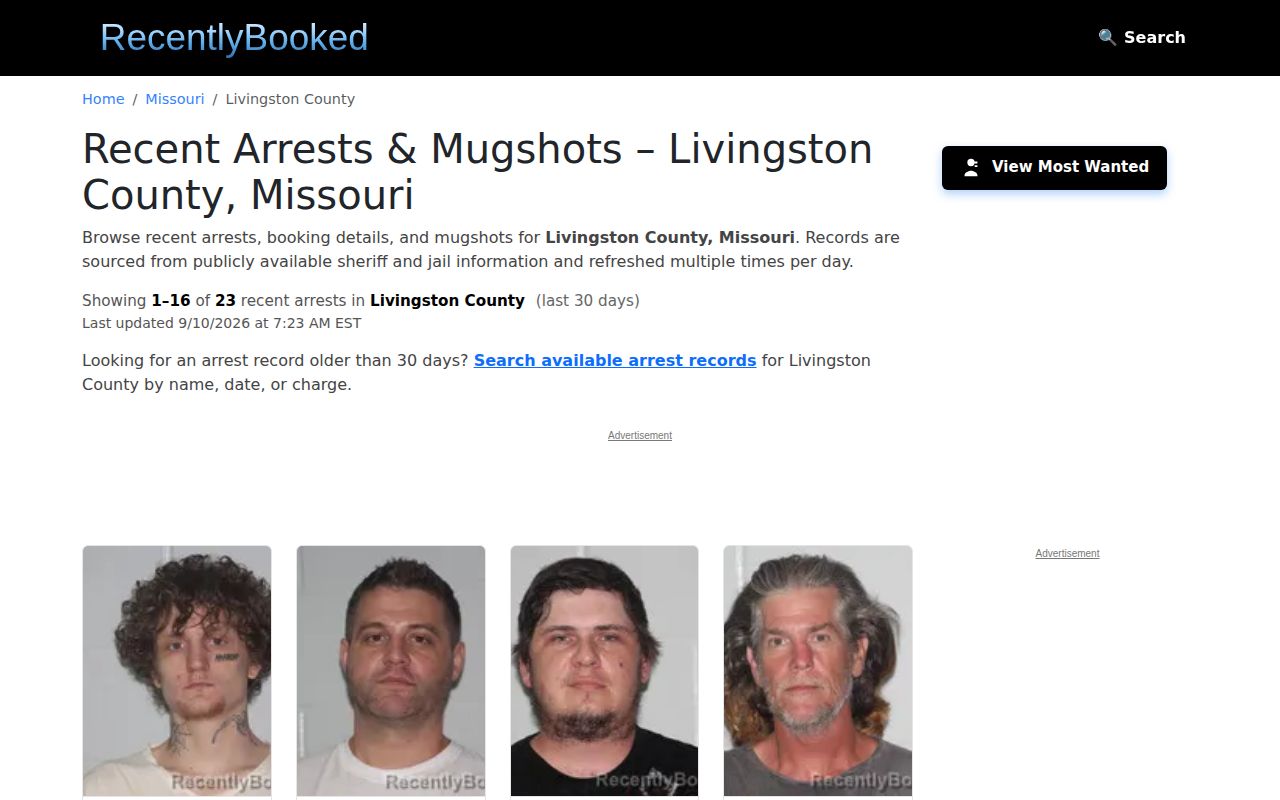
This is a secondary index. Verify every detail with the sheriff and the court. Arrests.org and Mugshots.com keep local historical indexes, and Mugshots.zone lists regional DDRJ examples. Their dates, identities, and custody states can lag or conflict. None replaces the sheriff's record.
Archive Livingston Arrest Records
Livingston County keeps no fixed online retention window for its arrest records. The 48-hour roster span covers current bookings only. The press-release index is selective rather than complete in its coverage. Want something older? Ask the office that actually created the record. A focused written request works best. It should carry the name, the date range of the incident, the location, the agency involved, and a booking number if you have one.
Missouri law shapes the request itself. Statute §610.023 sets out the custodian and response process. §610.026 governs lawful costs and estimates. LCSO posts no universal photo fee, so ask for an estimate up front. The Missouri State Archives holds historical corrections material, though old Livingston booking photos do not routinely land there.
Call LCSO at 660-646-0515 to confirm the right custodian before filing anything broad. The office sits at 901 Webster Street in Chillicothe. Visitors are asked to arrange an appointment. Even a granted arrest report may omit closed, juvenile, sealed, or protected material.
Livingston Reports Need Court Checks
Livingston Highway Enforcement Reports
The August 2026 sheriff report anchors the blotter in a concrete enforcement setting. It describes traffic work along U.S. 36, U.S. 65, and Highway 190, funded through Missouri Department of Transportation highway-safety grants. Those grants explain why traffic contacts and citations cluster in a periodic release. They do not prove any arrest trend. They should never be stretched into an annual arrest count.
Keep the event types straight. A traffic stop, a citation, a warrant service, and a custodial booking are four different things. Some stops end with paperwork only. Some arrests end with release on summons, while others mean transport to CCDC. Read the stated outcome instead of treating every enforcement item as a jail admission. The arresting agency may not even be LCSO. That stays true even when the LCSO roster carries the booking.
Livingston Report Dates Differ
Up to four dates can attach to one Livingston arrest: the incident date, the arrest date, the booking timestamp, and the release publication date. Prosecutors add a fifth when they file a case. News outlets may publish on yet another day. Sorting these apart keeps a monthly recap from being mistaken for a same-day feed, and it stops an old incident from reading like a fresh arrest.
Note the source beside each date. The roster supplies processing time when shown. A Chillicothe bulletin can add police narrative and transport detail. A sheriff release adds context. Case.net supplies the docket and disposition. When sources conflict, the custodian or a corrected court record beats any unofficial copy.
Some Livingston Reports Stay Closed
Missouri law splits open arrest reports from investigative, sealed, juvenile, and other protected records. Section 610.100 covers arrest and incident reports along with the conditions for closing them. Section 610.120 limits public access to closed records. So a gap in the archive may reflect a publication choice or a legal limit. The event is not missing. An agency may deny a request in whole or in part. Ask for a written explanation.
Never infer hidden facts from a redaction. Victim details and safety-sensitive information get removed. A bulletin may summarize far less than the underlying report holds. Treat the public narrative as a lead toward the official record, not a license to fill the gaps with guesses.
The Livingston County Sheriff's Office puts out periodic arrest releases, though its own notice keeps some details thin. A summons entry means the person was released while the process moved ahead. A transfer line only shows where an arrest subject was held in custody.